
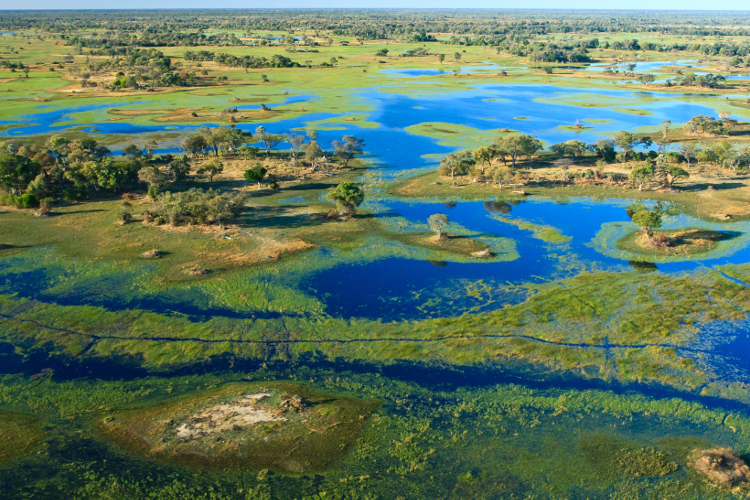
The Okavango is one of the World Heritage Site and one of the most sought after wilderness destinations in the world. A journey to the Okavango Delta – deep into Africa’s untouched interior – is like no other. Moving from wetland to dryland – traversing the meandering palm and papyrus fringed waterways, passing palm-fringed islands, and thick woodland, resplendent with lush vegetation, and rich in wildlife – reveals the many facets of this unique ecosystem, the largest intact inland delta in the world.
The Okavango Delta is situated deep within the Kalahari Basin, and is often referred to as the ‘jewel’ of the Kalahari. Shaped like a fan, the Delta is fed by the Okavango River, the third largest in southern Africa. Swollen with floodwaters from the summer rains, the Okavango River travels from the Angolan highlands, crosses into Botswana at Mohembo in the Caprivi, then later spills over the vast, fan-shaped Delta.
At the Delta’s lower reaches, the perennial swamps give way to seasonal swamps and flooded grasslands. To the southeast the third vegetation region becomes evident, as it changes to true dryland. There are three major land masses here: the Matsebi Ridge, Chief’s Island and the Moremi tongue. Here the vegetation is predominantly mophane, acacia and scrub bush and the land is dotted with pans. It is to this region that large numbers of mammals retreat during the dry winter months.
Major tourist attractions in the Delta and the dryland areas are game viewing, birding and boating, often in the traditional mokoro. The diversity and numbers of animals and birds can be staggering. A recent overview of the Okavango records 122 species of mammals, 71 species of fish, 444 species of birds, 64 species of reptiles and 1300 species of flowering plants. A successful rhino reintroduction programme in the Okavango now puts the population of White Rhino at approximately 35, and Black Rhino at 4.At the Delta’s lower reaches, the perennial swamps give way to seasonal swamps and flooded grasslands. To the southeast the third vegetation region becomes evident, as it changes to true dryland. There are three major land masses here: the Matsebi Ridge, Chief’s Island and the Moremi tongue. Here the vegetation is predominantly mophane, acacia and scrub bush and the land is dotted with pans. It is to this region that large numbers of mammals retreat during the dry winter months.
Features to look for: Elephant.buffalo, giraffe, zebra, hippo, crocodile, rhino, red lechwe, waterbuck, reedbuck,duiker,impala, kudu, steenbok, wildebeest, hartebeest , sable,| roan ,tsessebe, lion, leopard ,cheetah,| genet, serval, and caracal,| along with an immense variety of birds – land and water, resident and migratory, some of which are rare and endangered.