

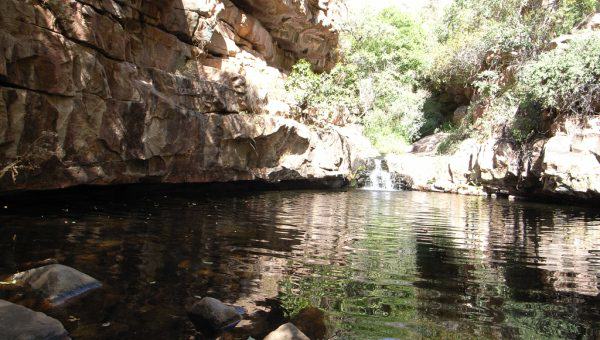
Tswapong Hills rise almost four hundred metres above the surrounding plains. These one-billion year-old titans extend 60 kms west of the village of Moremi, and measure a full 20 kms in breadth. Comprised of sandstone, ironstone and quartzite, which give them their characteristic rich hues, Tswapong holds numerous fascinating, and very beautiful, archaeological, historical and natural history sites..
Big game used to occupy this area, but now the hills are home to such mammals as rock dassies, baboons, brown hyena and leopard. Over 350 species of birds have been recorded in the area, including the endangered Cape Vulture, the Black Eagle, the Black Stork and the beautiful Meyer’s Parrot, as well as over a hundred butterfly species. One of the biggest draws is the lush, wet vegetation and a series of waterfalls – uncharacteristic of Botswana’s generally dry, waterless terrain.
The hills absorb water from deep aquifers in the ground and accumulated rain from above, releasing it in natural fresh springs scattered throughout the hills, which in turn form brooks and – with greater accumulations of water – waterfalls that collect in beautiful lagoons.